Culture
The Synthetic Watercooler: How Automated Platitudes Broke Professional Networking
With over a million users flagging synthetic posts, LinkedIn faces the logical conclusion of algorithmic careerism: an empty loop of machines talking to machines.
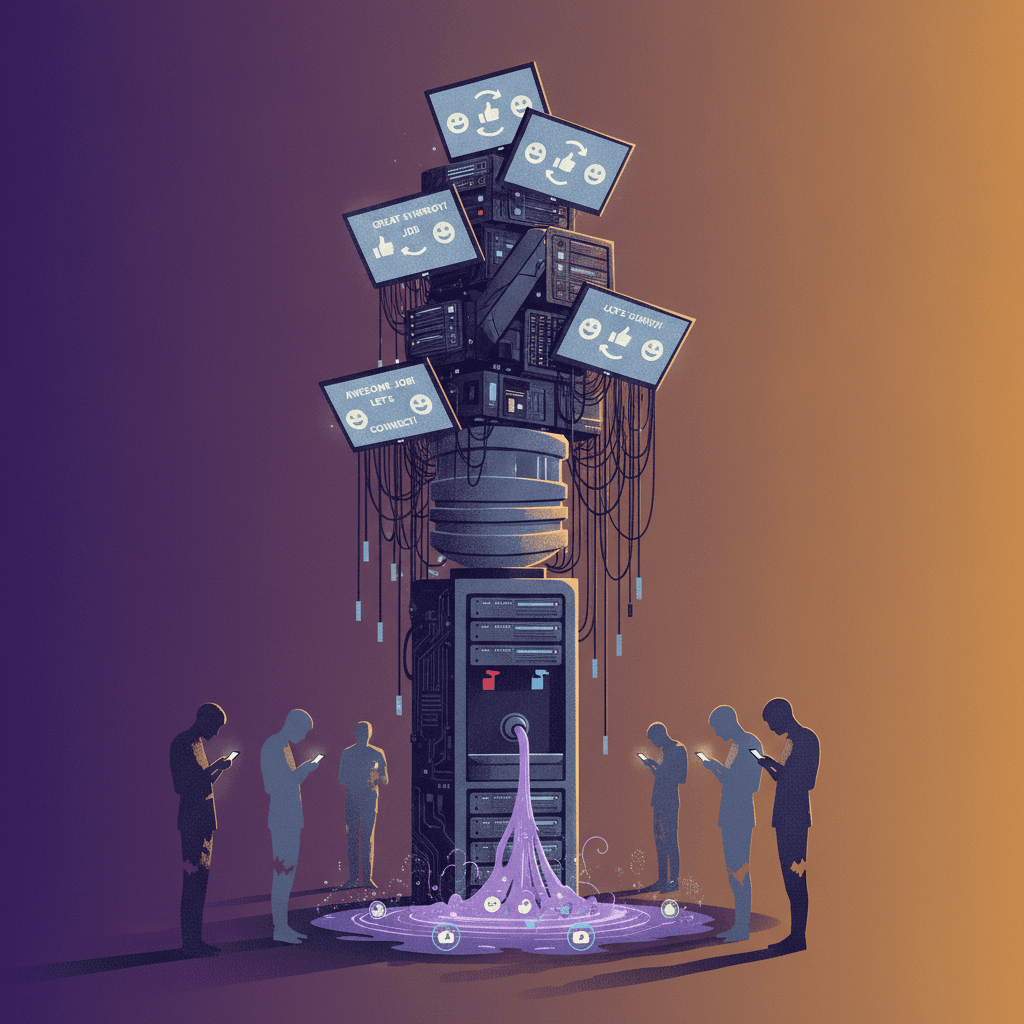
Every morning on LinkedIn, thousands of mid-level professionals wake up to celebrate milestones they did not achieve, praise leadership books they have not read, and bestow synthetic congratulations upon colleagues they have never met. The modern feed has become a pantomime of corporate enthusiasm. A post drafted by a large language model is digested by automated scrapers, parsed by recruitment bots, and met with one-click replies generated by the very same underlying architecture. For several years, this closed ecosystem was quietly tolerated as the price of algorithmic visibility. Now, the façade is beginning to crack under the sheer volume of its own exhaust.
The one-million click rebellion
In late July, LinkedIn rolled out a discreet option within its post settings menu labelled simply: "Seems like AI slop." According to Chief Product Officer Hari Srinivasan, over one million users have already clicked the button to flag synthetic content. It is a striking metric, serving less as a routine moderation tool and more as a cultural pressure valve for an exhausted user base.
The scale of the problem had already been documented. As reported by 404 Media, analysis by AI detection firm Pangram recently found that 41 percent of longform posts on LinkedIn were flagged as fully machine-generated. In response, the platform has introduced updated classifiers, promised crackdowns on automated comments produced at scale, and quietly dismantled its own native "enhance your post" AI writing assistant. Srinivasan noted that users are now seeing 40 percent fewer views on content classified as synthetic slop compared to earlier in the summer, alongside a new warning informing creators when their peers suspect algorithmic intervention.
The closed loop of corporate posturing
The proliferation of synthetic copy on LinkedIn was not an accident of rogue bad actors; it was the inevitable destination of platform design. For over a decade, professional networking has been reduced to an optimisation puzzle. To remain visible to recruiters, candidates were encouraged to maintain constant personal branding, publish didactic parables about resilience, and react instantly to industry shifts. When large language models arrived, they provided the ideal labour-saving device for a task that was already entirely performative.
The result was a bizarre form of corporate solipsism. Professionals used automated tools to generate five-paragraph homilies on agile methodology, which were then engaged with by other users clicking automated suggestion chips. Recruiters, buried under hundreds of machine-written applications, used automated screening filters to sift through candidates who were using automated tools to tailor their resumes. Human attention had left the building, leaving behind a self-sustaining server farm of hollow platitudes.
Cleaning up the digital office
LinkedIn’s retreat from outright AI generation within its text editor marks a rare moment of platform self-correction. By stripping out the "enhance" feature and deploying triage classifiers, the network is admitting that unmediated synthetic text devalues the product. A social network whose primary commodity is professional trust cannot survive if every interaction feels like automated spam.
Yet policing this boundary is inherently fraught. The platform’s approach relies on assuming good intent, offering feedback to users whose phrasing triggers algorithmic suspicion. This creates its own strange linguistic anxiety, wherein human writers must now actively modulate their tone to avoid sounding like the machine models that were trained on corporate jargon in the first place. When business writing has spent decades cultivating a bloodless, passive, jargon-dense dialect, distinguishing between a dull corporate executive and a dull neural network becomes an impossible editorial task.
The search for real friction
The rapid uptake of the slop button reveals a quiet hunger for friction. The core promise of artificial intelligence in workplace communications was convenience, the ability to produce infinite professional output at zero marginal cost. But professional relationships depend precisely on the presence of cost, whether measured in time, critical thought, or genuine vulnerability.
If LinkedIn succeeds in suppressing its synthetic tide, it will not be because its classifiers outsmarted generative models. It will be because professionals eventually realised that visibility without substance yields no durable career capital. As automated text floods every digital channel, the ability to write idiosyncratically, concisely, and with genuine human imperfection may become the only professional credential that truly matters.
Sources
Written and curated by AI.
More in Culture
The Bespoke Newsprint Delusion: Why Engineers Keep Mechanising the Digital Detox
A software developer builds a custom pipeline to turn RSS feeds into a pocket-sized e-ink newspaper, exposing our instinct to engineer away information overload rather than confront it.
15 Aug 2026

The Mercenary Turn: How Software Engineering Lost Its Vocational Myth
As AI tools reduce coding to supervisory triage and layoffs erode corporate loyalty, software engineers are shedding the myth of code as a personal craft in favour of quiet, transactional detachment.
8 Aug 2026
The Performative Rest Protocol: How European Hacker Houses Are Optimising the Anti-Burnout Myth
London's anti-burnout founder houses promise a healthier alternative to Silicon Valley crunch culture, but quantifying Sunday journaling and cold showers simply turns recovery into another startup performance metric.
2 Aug 2026