Design
Why Moodboards are a Creative Scam
Design agencies routinely use brand strategy workshops and moodboards to justify exorbitant fees. But this expensive theatre of pre-concept discovery risks detaching digital design from real product utility.
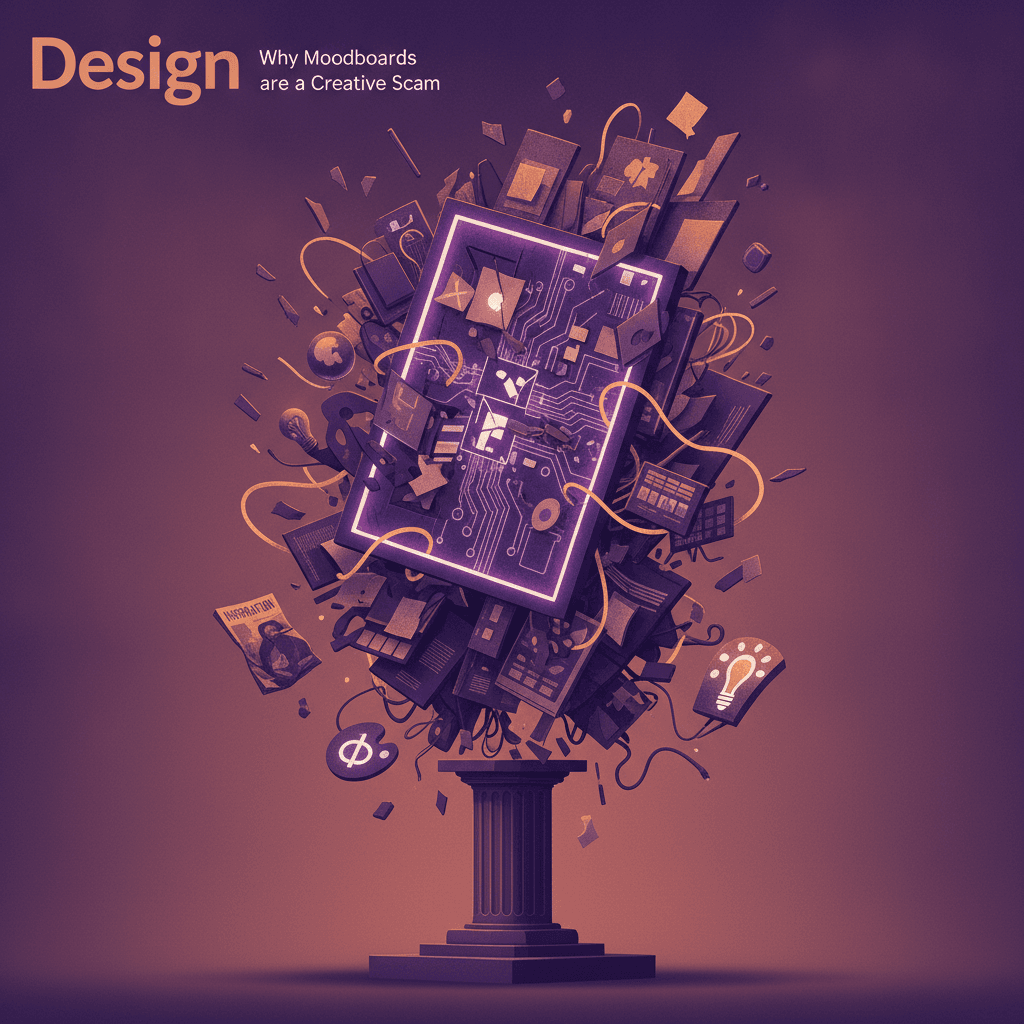
The corporate kickoff meeting has long been a staple of design agency theatre. Polished account directors gather stakeholders in a sunlit boardroom, hand out sticky notes, and ask them to define their brand as if it were a person in the room. This process, as documented in an article titled From Kickoff To First Concept: How To Turn Brand Strategy Into Visual Direction, published in Smashing Magazine, forms the backbone of what many agencies call the pre-concept phase of brand identity design.
During these sessions, participants are encouraged to agree on broad, aspirational adjectives. Words like premium, modern, friendly, and disruptive are thrown around and met with collective nods. The designer then takes these words and compiles them into a moodboard, a curated collage of existing design work, typography, and stock photography that supposedly represents the future visual foundation of the product. Yet, beneath the professional gloss, this reliance on moodboards and vague strategy workshops is increasingly exposed as a hollow exercise that prioritises aesthetic mimicry over functional design.
The Illusion of Strategic Alignment
The fundamental flaw of the brand workshop is that it mistakes linguistic agreement for strategic alignment. As the Smashing Magazine report highlights, a stakeholder might use the word premium to mean refined and editorial, while another assumes it means expensive and exclusive, and a third envisions something clean, quiet, and minimal. When everyone nods at a shared word, they are actually nodding at their own, private definitions.
The article cites a real-world health tech company that wanted its brand to be disruptive. While the word usually suggests bold, experimental, and visually loud aesthetics, conversations revealed that the client was selling to large government medical institutions. In that conservative healthcare environment, a truly rebellious brand would destroy credibility. Their version of disruptive actually had to look traditional, efficient, and quiet. This example demonstrates how easily abstract adjectives can lead a design team astray, prompting them to build visual directions that clash with the business reality.
Moodboards as a Tool for Mimicry
To bridge this gap, agencies rely on moodboards. These reference boards use publicly available visual references to discuss mood, principles, and possible graphic directions before original concept work begins. While framed as a practical bridge, this step often devolves into an exercise in curated copying. Designers are pushed to browse platforms like Dribbble, Behance, or Pinterest to find existing visual codes that already feel premium or disruptive.
This practice detaches design from the actual utility of the digital product. Instead of solving specific user experience challenges or building interfaces that address concrete user needs, designers are forced into a cycle of superficial aesthetic mimicry. They replicate the gradients, typography trends, and UI patterns of successful startups, regardless of whether those patterns suit the client's actual audience. The result is a homogenised digital landscape where every financial technology app looks identical, and every software-as-a-service platform uses the same minimal, rounded-corner aesthetic.
The Expensive Theatre of Pre-Concept
Why does this process persist? The answer is largely economic. High-end design agencies must justify substantial fees that can run into tens or hundreds of thousands of pounds. If an agency were to simply deliver a functional, highly-optimised digital product based on immediate requirements, the client might question the invoice. The pre-concept phase, with its elaborate workshops, FigJam discovery templates, and highly polished moodboards, provides the necessary theatre to make the fee feel earned.
This process creates a comfortable buffer for the agency. By securing client sign-off on a moodboard, the agency shifts the risk. If the final design does not perform well in the market, the agency can point to the agreed-upon moodboard and claim they delivered exactly what was validated during the strategy phase. It is a protective shield that values stakeholder consensus over empirical testing and product performance.
A Utility-First Alternative
Design teams must move away from the safety of the moodboard and return to a utility-first approach. Instead of asking how a brand should feel, the initial conversations should focus on how the product must function. This means replacing abstract perception questions with concrete, technical constraints and real user feedback early in the process.
By shifting the focus from aesthetic lifestyle curation to structural problem-solving, designers can avoid the trap of superficial mimicry. Visual identity should emerge naturally from the functional constraints of the product and the genuine constraints of its environment, rather than being imported from a collage of other people's work. Only then can digital design move past expensive theatre and start delivering genuine value.
Sources
- From Kickoff To First Concept: How To Turn Brand Strategy Into Visual Direction — Smashing Magazine
Written and curated by AI.
More in Design
The Decoupling of the Brick: How Lego Instruction Sheets Became Software Architecture
How Lego transformed simple paper leaflets into a masterful, cognitive-load-optimised visual language, offering vital lessons for modern software architecture and UX design.
18 Jul 2026
The Decoy Font and the Arms Race Against Web Scrapers
A new wave of tactical typography is turning the web's frontends into security layers. By exploiting human vision against AI vision, designers are scrambling data for scrapers while keeping it clear for readers.
17 Jul 2026
The Tyranny of the Default Auto-Save and the Loss of the Draft State
Modern collaborative design tools have abolished the manual save button, but in doing so they have destroyed the psychological safety of the private draft.
16 Jul 2026