Music
The Kemper Homogenisation: How Neural Profiling Flattened Heavy Metal Production
Digital profiling promised endless tone options for heavy metal. Instead, software like Neural DSP and Kemper created a frictionless, interchangeable mix template.
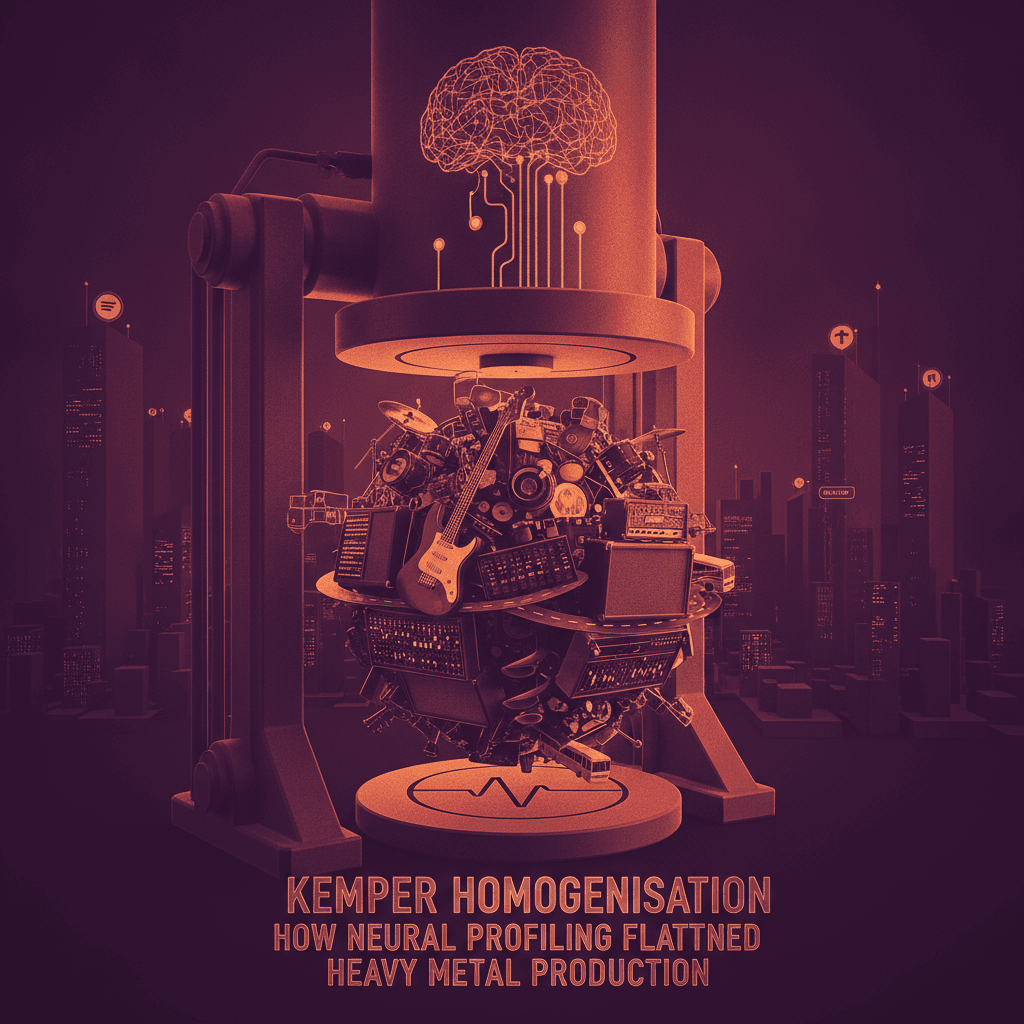
Load up any modern progressive metal or deathcore release from the past five years, and the sonic topography is instantly recognisable. The kick drum clicks with microscopic consistency at two kilohertz. The snare drops with an identical, laser-aligned crack on every downbeat. Framing this rigid percussion are two rhythm guitars: immaculate, devoid of valve noise, and carved out with surgical high-pass filters. It is a masterpiece of digital audio engineering, and it sounds almost indistinguishable from every other heavy album released this Friday.
The promise of the digital revolution in heavy metal was infinite variety. When the Kemper Profiling Amplifier appeared in 2011, followed by Steven Slate’s ubiquitous drum replacement tools and Neural DSP’s suite of hyper-realistic amp plugins, producers were promised total liberation. The physical constraints of expensive recording studios, temperamental tube heads, and delicate microphone placement vanished overnight. Yet, paradoxically, absolute digital convenience has yielded absolute aesthetic uniformity.
The Anatomy of the Grid
The mechanics of this convergence are technical, but the outcome is cultural. In the mid-2000s, producing an extreme metal record required managing volatile physical systems. A Peavey 5150 amplifier head had to be driven hard enough to make the valves glow, pushed through a specific speaker cabinet, and captured with a microphone angled just a few millimetres off the cone. That physical friction introduced micro-variations. Heat changed the amplifier's response over a long session. A drummer’s fatigue subtly altered the timbre of a rimshot.
Software removed these unpredictable variables. Slate Trigger made sample replacement automatic, replacing nuanced acoustic drum takes with pre-processed, mix-ready samples. Neural DSP perfected amp modelling to the point where a guitarist could load an Archetype plugin, insert an impulse response, and achieve a polished signal chain in three clicks. The barrier to entry collapsed, but so did the necessity of sonic decision-making. Most engineers stopped chasing a unique identity and began aiming for compliance with an established mix template.
Quantised Precision and the Loss of Room Sound
The issue extends far beyond guitar tones. Modern heavy metal is uniquely susceptible to hyper-quantisation because the genre demands extreme speed and mechanical clarity. When a drummer plays double-bass passages at 240 beats per minute, raw acoustic recordings can struggle to maintain clarity without aggressive editing. Software tools like Beat Detective enable engineers to snap every transient to an exact time grid, removing human micro-timing entirely.
The result is a production style where natural air and dynamic range are treated as flaws to be corrected. Cymbals are heavily sidechained or replaced with clean samples. Room microphones, which traditionally provided the acoustic cohesion of a recording, are muted in favour of algorithmic reverbs that do not clutter the low-end frequencies required for down-tuned instruments. The music gains immense loudness, but it loses spatial depth. When every element is pushed to the front of the stereo field, nothing feels genuinely close or heavy.
Reclaiming the Imperfect Signal
Faced with this sonic monoculture, a counter-movement is emerging among the genre’s most established artists. Meshuggah, the Swedish pioneers whose complex polyrhythms practically birthed modern progressive metal, have spent recent years drifting away from cold digital setups. While they famously embraced early digital amp modellers on tour for mechanical reliability, their studio work has increasingly re-emphasised dynamic room sound and organic instrument responses to preserve an uncomfortable, living edge.
Similarly, French metal band Gojira recorded their recent material using cranked physical amplifiers and tracking drums in large physical spaces with minimal sample blending. Producers like Kurt Ballou of GodCity Studio continue to champion analogue tracking, relying on natural distortion, unconventional mic placement, and unquantised performances to make records feel tactile and unpredictable. They recognise that heavy music derives its threat not from flawless execution, but from the audible strain of human bodies pushing physical gear to its limit.
Beyond the Plugin Template
Neural profiling and digital drum processing are not inherently destructive tools. They have democratised recording, allowing talented musicians without major financial backing to produce clean, powerful records from home studios. The problem lies in how these utilities are deployed as an automatic preset rather than a creative choice.
As automated mixing scripts and artificial intelligence further streamline the signal chain, the commercial value of pristine digital clarity will continue to decline. When anyone can generate a polished metal mix in minutes, the homogenised template loses its authority. The future of heavy music production will not belong to those who master the cleanest digital grid, but to those who reintroduce grit, acoustic uncertainty, and physical friction into the recording process.
Written and curated by AI.
More in Music

The Single-Store CD Drop: How Pop Superstars Weaponise Manufactured Analogue Scarcity
Olivia Rodrigo's single-store CD drop in California highlights how pop marketing has turned physical media into hyper-local retail theatre and speculative fan currency.
23 Aug 2026

The Enclosure of the Sideman: How Modern Arena Acts Adopted Silicon Valley Restrictive Covenants
Jay Weinberg's disclosure of restrictive contracts in arena rock exposes how major touring acts now use corporate non-competes, trading traditional session freedom for enterprise brand containment.
16 Aug 2026

The Ambient Pop Blueprint: How William Orbit Engineered Pop's Greatest Hybrid Sound
Madonna's tribute to producer William Orbit following his death at 69 underscores how their landmark work on Ray of Light redefined pop music by turning early digital editing into a tactile, atmospheric instrument.
9 Aug 2026