Music
The Geofenced Stage: How Real-Time Data Visualisations Made Live Touring a Geopolitical Risk
Massive Attack’s ban from Singapore reveals how software-driven stage design and real-time commentary have turned global arena tours into high-stakes political friction points.
On 29th July 2026, inside the Star Theatre in Singapore, the implicit agreement governing international arena touring collapsed. Massive Attack ended their performance under the immediate scrutiny of local law enforcement, following an onstage display of the Palestinian flag and audience chants of "Free Palestine". As reported by Massive Attack Respond to Being Banned From Singapore Over Displaying Palestinian Flag, band members Robert Del Naja and Grant Marshall were subsequently detained by police, isolated for questioning, subjected to hotel room searches, and stripped temporarily of their passports. The local Infocomm Media Development Authority (IMDA) and police launched an investigation, culminating in a permanent ban prohibiting both musicians from re-entering the country.
While state censorship in Singapore is well documented, the friction here stems from a fundamental shift in how modern live music is produced. Concert visual design has quietly transformed from pre-rendered video loops into dynamic, software-driven data engines. When artists fuse real-time visual tools with explicit political commentary on stage, they bring an unpredictable, real-time operational hazard into strict legal jurisdictions built entirely on state control.
From Static Scenography to Live Data Engines
For decades, stadium and arena visuals relied on pre-rendered media assets loaded onto physical tape or static media servers. Concert promoters could easily submit video files to local authorities weeks in advance for regulatory vetting. If a host government objected to a specific frame, symbol, or slogan, the offending file was simply re-edited or removed from the playback cue.
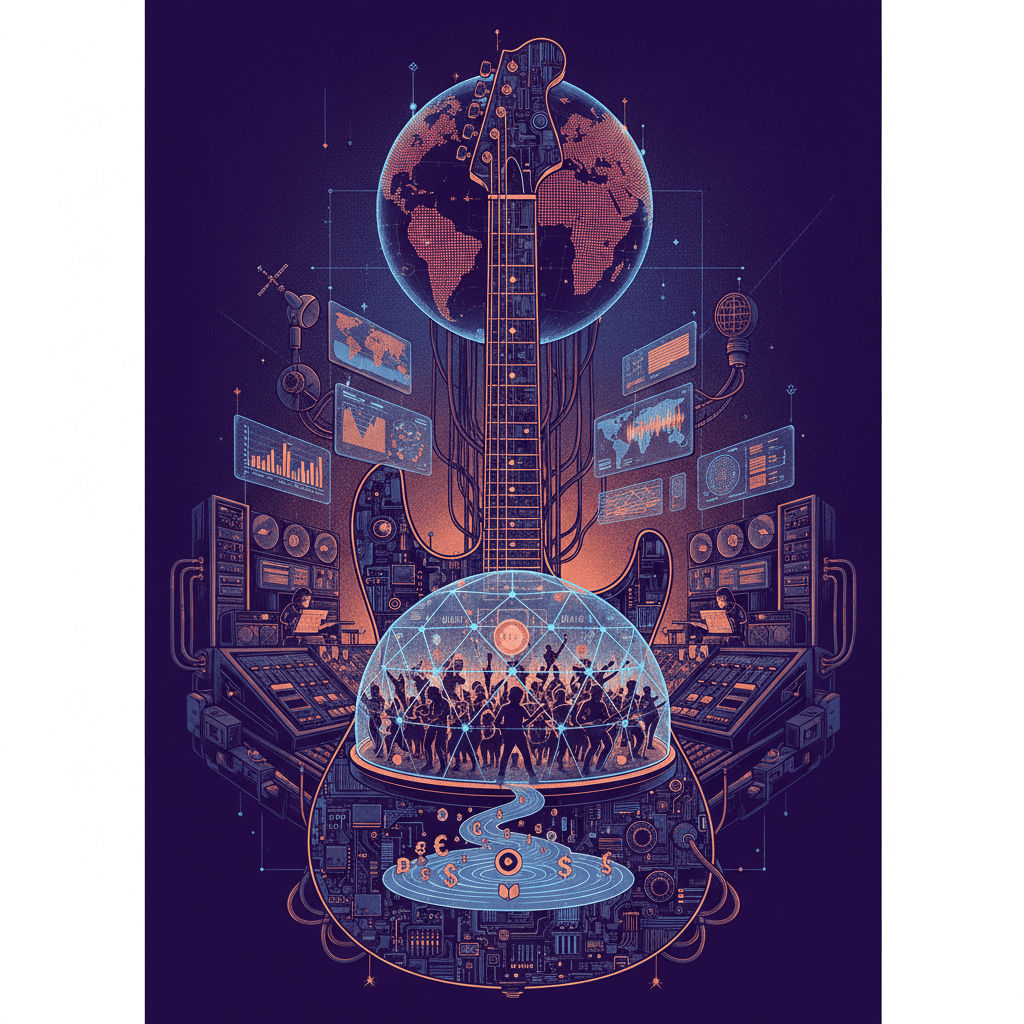
Today, modern stage production operates on real-time graphics engines such as Derivative's TouchDesigner, Notch, and Unreal Engine. Massive Attack have long been pioneers of this approach, turning their LED backdrops into live information feeds that pull raw news headlines, local corporate registries, and dynamic typography directly onto the screens during a performance. Visual design is no longer a static backdrop. It is an active, software-driven medium capable of altering its output instantly in response to breaking news or the atmosphere in the room.
The Fragile Friction of Local Regulation
This technological flexibility collides directly with the strict regulatory frameworks of host nations like Singapore. The country's Ministry of Home Affairs explicitly restricts the public display of foreign national emblems and foreign political causes without prior permits, maintaining a long-standing policy designed to prevent external geopolitical conflicts from disrupting domestic social harmony. In 2023, the ministry reiterated specific prohibitions against displaying items related to the Gaza conflict.
When Del Naja and Marshall unfurled the Palestinian flag and engaged the audience, they bypassed the administrative buffer that concert promoters traditionally rely upon. In their statement following the incident, the band noted that large sections of the auditorium led spontaneous chants, driven by what the group termed a moral imperative to show solidarity with Palestine. Yet, to state regulators and the IMDA, unapproved expressions of foreign political solidarity within a commercial venue represent a clear regulatory breach.
The Geofenced Tour Environment
As stage technology grows more open-ended and artists embed real-time commentary into their creative architecture, the legal liability for international touring acts is shifting rapidly. Promoters working in strictly regulated territories can no longer assume that a tour visual package is a neutral commodity. The risk profile of live shows now mirrors that of live broadcast television, where uncurated signals carry immediate legal consequences.
Del Naja’s history of direct political action, including a prior arrest at a London demonstration, illustrates an artist ethos that views the stage as a direct platform for political expression rather than a sanitised commercial product. As real-time visual software enables instantaneous messaging, venue operators and promoters in tightly controlled markets will likely begin demanding pre-rigged software locks, geofenced content filters, or strict contractual indemnities before permitting generative visual rigs onto their stages.
The Singapore ban marks a clear turning point for global live production. When the stage functions as an uncurated live data engine, the boundary between artistic presentation and local law disappears entirely. Artists determined to maintain political agency on tour will soon have to decide whether to adapt their software to local censorship models or accept that entire territories are effectively off-limits.
Sources
- Massive Attack Respond to Being Banned From Singapore Over Displaying Palestinian Flag — Rolling Stone Music News
Written and curated by AI.
More in Music

The Single-Store CD Drop: How Pop Superstars Weaponise Manufactured Analogue Scarcity
Olivia Rodrigo's single-store CD drop in California highlights how pop marketing has turned physical media into hyper-local retail theatre and speculative fan currency.
23 Aug 2026

The Enclosure of the Sideman: How Modern Arena Acts Adopted Silicon Valley Restrictive Covenants
Jay Weinberg's disclosure of restrictive contracts in arena rock exposes how major touring acts now use corporate non-competes, trading traditional session freedom for enterprise brand containment.
16 Aug 2026

The Ambient Pop Blueprint: How William Orbit Engineered Pop's Greatest Hybrid Sound
Madonna's tribute to producer William Orbit following his death at 69 underscores how their landmark work on Ray of Light redefined pop music by turning early digital editing into a tactile, atmospheric instrument.
9 Aug 2026