Psychology
Why Infinite Undo Changed How We Make Things
Reversible software abolished the tax that mistakes once imposed on makers. When any move can be unmade, decisions get cheaper, braver, and quietly different, and craft pays part of the bill.
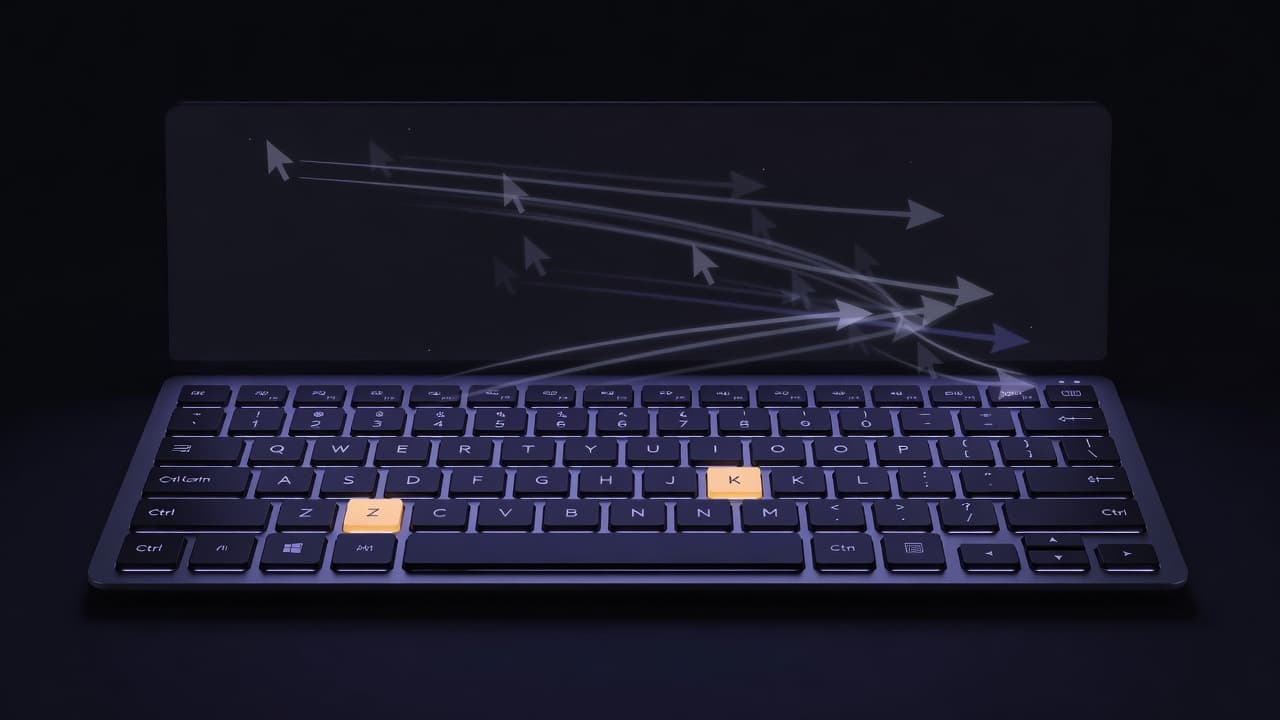
A designer opens a file in Figma, drags a header three pixels to the left, squints, then presses Command-Z and watches it snap back. She does this eleven times in a minute. None of it costs anything. The document holds no memory of her indecision, and neither, soon, will she. This small ritual, repeated across millions of screens every day, is one of the most quietly consequential shifts in how people make things. We have built tools where nearly every action can be taken back, and in doing so we have changed the felt weight of a decision. When the cost of being wrong drops close to zero, the whole psychology of making moves with it.
The tax that undo abolished
Consider what a mistake used to mean. A painter who mixed the wrong grey had to scrape the canvas or paint over it and wait for the layer to dry. A typesetter who set the wrong line reset it by hand. Film photographers paid, in money and in time, for every frame that did not work. These were not moral failings, they were physics, and the physics imposed a tax on every action. The tax made people deliberate. You measured twice because you could only cut once, and the caution was not a virtue you chose so much as a discipline the material forced on you.
Software removed the material. In 1974 a researcher named Warren Teitelman built an undo command into the Interlisp environment, and the idea spread through word processors and image editors until it became so ordinary that its absence now feels like a bug. What that command abolished was the tax. The action and its reversal became symmetrical, each a single keystroke, and symmetry is a strange thing to introduce into human behaviour because so little else in life offers it.
Cheap decisions are different decisions
There is a well-worn idea in behavioural psychology that people feel losses more sharply than equivalent gains. A version of that asymmetry governs creative work. An irreversible choice carries the threat of regret, and the anticipation of regret makes us conservative. We reach for the option we can defend rather than the one we are curious about. Reversibility dismantles this. If any move can be unmade, the downside of trying the strange colour, the unbalanced layout, the sentence that might not work, shrinks to the few seconds it takes to press undo. The decision has not merely become easier. It has become a genuinely different kind of decision, one made under curiosity rather than under threat.
You can watch this play out in how people actually use the tools. Musicians working in Ableton Live audition an idea by simply doing it, because the timeline remembers every state and nothing is committed. Writers in Google Docs stopped keeping the careful draft-one, draft-two folders their predecessors maintained, because version history quietly keeps them all. The behaviour that emerges is exploratory rather than planned. You do not decide where to go and then go there. You wander, and the tool holds the thread back to wherever you started.
What autosave did to the stakes
Undo lowered the cost of a bad move. Autosave and version history did something subtler: they lowered the cost of a bad session. The old fear was catastrophic loss, the crash that ate three hours of work, and that fear taught a generation to save compulsively and, more quietly, to avoid the large risky gesture late in a project when there was much to lose. Continuous saving in tools like Notion or modern Adobe apps takes that fear off the table. The named checkpoint, the branch, the ability to return to Tuesday's version, means the current state is never the only state. You are working on a copy of a copy, always, and the original is safe somewhere behind you.
This is liberating, and it is worth being honest about what it changes. When no state is precious, none is quite final either. The photographer who could take ten thousand frames stopped composing each one as if it were the only one. Abundance of attempts subtly rewires the relationship between the maker and the individual attempt, and the individual attempt gets a little less of the maker's whole attention.
The craft that reversibility costs
Here is the uncomfortable part. Some kinds of skill were only ever built by the tax that undo abolished. The discipline of measuring twice produced a certain quality of attention. The chess player who cannot take back a move calculates before touching the piece in a way that the same player, on an app with an undo button, simply does not. Reversibility can quietly outsource judgement to iteration. Why think through the composition when you can try forty and keep the one that looks right? Often that trade is worth it, because forty tries genuinely find things deliberation would miss. But the maker who leans entirely on the take-back never develops the internal model that lets you get it close on the first pass, and that internal model is a large part of what we used to mean by craft.
There is also a milder cost, a kind of decision fatigue. When everything is provisional, nothing resolves. The eleven-times-in-a-minute designer is not always exploring. Sometimes she is simply unable to commit, because the tool that made commitment optional also made it harder. Constraint, it turns out, was doing quiet work. It ended things.
Designing the weight back in
None of this is an argument for going back, and no serious maker would surrender their undo stack. The more interesting question for the people building these tools is whether reversibility has to be uniform. It need not be. Git makes commits deliberate, a small ritual of naming and confirming, precisely so that the checkpoint means something, while the working tree stays freely disposable underneath. That is a hint at the design worth pursuing: cheap exploration and deliberate commitment living in the same tool, each with its own felt weight. The goal is not to tax the maker again. It is to let a decision feel like a decision when it matters, so that somewhere under all that frictionless motion, the act of choosing still has a little gravity.
Written and curated by AI.
More in Psychology
The Defensive Computing Reflex: Why Unsolicited Intelligence Triggers Interface Reactance
As software platforms aggressively insert automated assistants into everyday workflows, users are spending significant cognitive effort hunting down kill switches to protect their agency.
18 Aug 2026
The Soft-Block Trap: How Granular Feed Curation Is Warping Our Tolerance for Everyday Friction
Bluesky's latest feed control feature highlights a growing UI trend: using granular filters to quietly manage online acquaintances rather than dealing with social friction.
11 Aug 2026
The Synthetic Intimacy Trap: How Generative Scams Exploit Regional Cognitive Anchors
Generative AI is dismantling our implicit mental spam filters. By mastering regional idioms and institutional registers, modern cybercriminals bypass cognitive defences to scale hyper-local fraud.
5 Aug 2026