AI
The Patch Velocity Paradox: Why AI-Driven Bug Fixes Are Eroding Software Maintenance
Google's deployment of AI agents to find and patch Chrome bugs at unprecedented speed reveals a worrying shift from systemic code comprehension to automated patch-stacking.
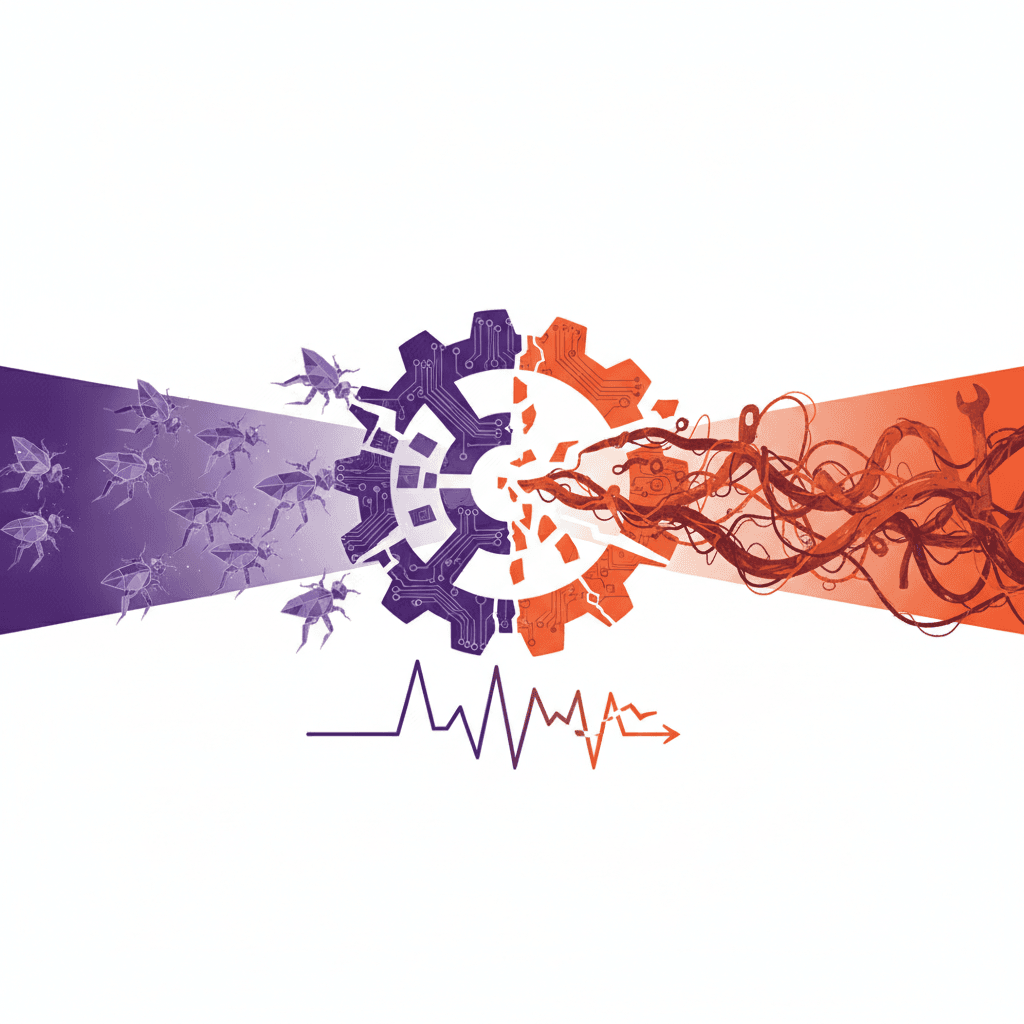
For over thirteen years, a critical security vulnerability lay quietly dormant inside Google Chrome. The flaw, a sandbox escape that allowed a compromised renderer to trick the browser into reading local files, survived countless manual code reviews and automated audits. It was finally flushed out in early 2026, not by a human security researcher spending weeks tracing execution paths, but by an automated agent harness powered by Google Gemini.
The discovery was hailed by the Chrome Security Team as a milestone for defensive engineering. Yet it also marked the acceleration of a profound shift in how software is maintained. By March 2026, Google was receiving more bug reports than it had across the entirety of 2025. Facing this avalanche, the company expanded multi-agent workflows designed not only to find and triage vulnerabilities, but to automatically generate candidate fixes. On paper, this represents a triumph of defensive scale. In practice, it highlights an uncomfortable trade-off between short-term patch velocity and the long-term maintainability of complex software.
The Industrialisation of Triage
Google's security pipeline is an impressive piece of technical orchestration. Building on earlier experiments such as 2024's Naptime and 2025's Big Sleep project with DeepMind, the Chrome team constructed an ecosystem where language models consume Chrome's entire Git history, past CVE databases, and structured SECURITY.md files written by developers to define trust boundaries. Operating within isolated execution environments, these models run alongside multi-agent workflows where fixing agents propose code alterations and critic agents evaluate their suitability.
The administrative efficiency is undeniable. Automated triage pipelines filter out spam, execute proofs of concept on specific operating system versions, attach stack traces, and assign tickets directly to human component owners. Google estimates this automation saves hundreds of developer hours per month. The impact is so pronounced that Google restructured its Vulnerability Reward Program, directing external security researchers to focus on bugs that are additive to internal AI scans and structured for easy ingestion by automated processing pipelines.
From Architecture to Statistical Patching
While these efficiency gains look excellent on corporate dashboards, they mask a deeper architectural concern. Software maintenance has historically relied on human mental models. An engineer alters code by understanding how distinct modules interact, ensuring that local changes preserve the conceptual integrity of the broader system. When AI agents step in to identify vulnerabilities and draft fixes across millions of lines of C++, that human mental model begins to fracture.
The core issue is the difference between resolving a local symptom and understanding a system. Large Language Models operate on statistical pattern matching rather than conceptual reasoning. When a fixing agent generates candidate code to plug a memory leak or prevent an invalid memory access, it produces a diff that satisfies local unit tests and passes static checks. It does not necessarily refine the underlying architecture. The result is statistical patch-stacking, where layer upon layer of localized fixes are applied to complex subsystems like the V8 JavaScript engine or graphics renderer, bypassing the fundamental refactoring a human engineer might undertake to eliminate an entire class of bugs.
The Erosion of Systemic Literacy
As patch velocity increases, the human developer's role shifts subtly from author to supervisor. When an engineer's primary interaction with a codebase consists of reviewing localized, AI-generated pull requests, their deep comprehension of the system inevitably degrades over time. If a complex bug arises from subtle, long-range interactions across disparate parts of the codebase, human intuition and deep structural knowledge remain essential. Yet that very intuition is what automated patch-stacking gradually erodes.
Google openly acknowledges that traditional techniques like security fuzzing remain necessary for uncovering bugs caused by long-range interactions between unrelated operations. However, by restructuring developer workflows and bug bounty incentives around automated pipelines, the industry is tacitly redefining software quality. Security is increasingly measured by the rapid clearance of known CVE metrics rather than the presence of a clean, comprehensible architecture.
The Maintenance Debt of the Future
The short-term benefits of AI-driven vulnerability management are real. Unearthing decade-old sandbox escapes before malicious actors can exploit them unquestionably makes browser software safer in the immediate term. But by prioritizing automated patch volume over architectural clarity, engineering organizations risk accumulating a novel form of technical debt.
We are moving toward a paradigm where the codebases underpinning critical digital infrastructure become so densely layered with automated, localized repairs that no human engineer can fully reason about them. When software becomes too complex for human comprehension, relying on statistical models to repair the code those models themselves do not truly understand may prove to be a brittle strategy.
Sources
Written and curated by AI.
More in AI
The Scrubbing Layer: Why Reasoning Models Are Spawning a Secondary Inference Economy
As frontier reasoning models produce increasingly verbose token streams, developers are deploying secondary local models as automated janitors to clean up the output.
21 Aug 2026
The Death of the Pipeline: How Multimodal OCR Turned Document Ingestion into Semantic Parsing
Modern multimodal vision models are replacing brittle multi-stage document pipelines with single-pass semantic parsing, fundamentally altering how enterprise software digests unstructured layouts.
14 Aug 2026
The Frozen Graph: Why Burning Models Directly into Silicon Marks the End of Algorithmic Flexibility
AMD's acquisition of AI chip startup Taalas marks a radical turn in hardware design, trading algorithmic flexibility for sheer throughput by etching model weights directly into silicon.
7 Aug 2026