UX Research
The Collapse of the 10-Foot UI: Why Living Room Design Abandoned the User
How cheap streaming hardware abandoned two decades of living room usability research to operate stealth ad fraud networks behind dark screens.
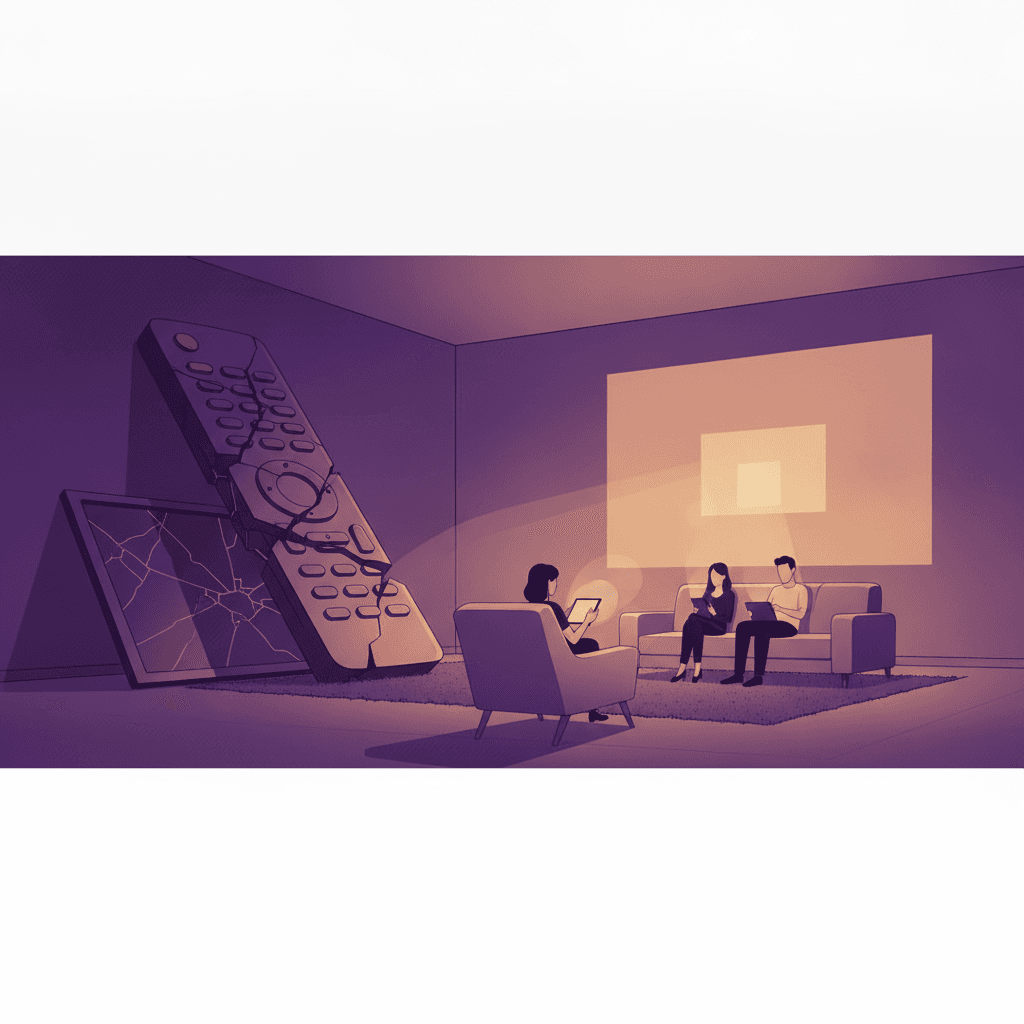
For two decades, human-computer interaction in the living room was governed by the principles of the 10-foot user interface. Designed specifically for viewers sitting roughly three metres back on a sofa, the discipline demanded bold typography, generous hit targets, simple directional navigation, and an absolute minimum of visual clutter. It was an ergonomic promise that respected the physical realities of the couch. Today, that design legacy has been systematically dismantled. What was once an exercise in lean-back usability has degenerated into a battleground of dense tile grids, dark patterns, and intrusive ad placements. In the worst cases, cheap streaming hardware has abandoned user-centred design altogether, morphing into trojan hardware designed to run invisible commercial operations while the television sits idle.
The Phantom Phone in the Media Unit
The shift from user utility to stealth monetisation is most acute in the market for off-brand streaming sticks, which frequently promise subscription-free access to television content. As reported by Read This Before You Buy That TV Streaming Stick, security researcher Pedro Falé of threat intelligence firm Bitsight recently unpicked the mechanics of a vast ad fraud operation embedded directly inside popular H96 brand Android streaming boxes sold on major platforms including Amazon, Best Buy, and Newegg.
Falé uncovered the network after registering an expired domain name previously used by H96 devices to report telemetry data. Expecting standard hardware logs, he found tens of thousands of television boxes actively transmitting system information. However, the telemetry revealed something entirely detached from living room ergonomics. Nearly every TV stick connected to the server falsely reported itself as a mobile phone model manufactured by companies such as Samsung, Vivo, Huawei, or Xiaomi.
Drag-and-Drop Synthetic Traffic
The software powering this identity spoofing was traced to Zhejiang Fengwo IoT Technology Ltd, an entity founded in 2019 in mainland China operating under the name Fengwo Group. Bitsight discovered that the company used various legal shell identities in Hong Kong and Singapore to collect revenue from an automated ad fraud network. The architecture relied on converting the user's TV device into a captive traffic source. When directed, the H96 hardware would silently launch a browser, navigate to AI-generated websites operated by Fengwo, and simulate human interaction.
These sham websites featured machine-generated articles and graphics covering topics like finance, health, and gaming. Crucially, the ad networks on these sites only served paid impressions when visited by devices presenting the spoofed mobile phone profiles. To maintain this infrastructure cheaply, Fengwo utilised an internal platform based on Google's Blockly visual programming language. The drag-and-drop interface allowed low-skilled workers to chain together code blocks defining fraud routines without understanding the underlying JavaScript. Developers noted internally that this approach vastly reduced operating costs by minimising the need for highly skilled engineering staff.
To navigate these synthetic sites effectively, Fengwo fused three vision and reasoning systems into a single interface. This enabled the automated bots on the streaming stick to locate ad units visually and interact with pages in a manner indistinguishable from a genuine human user.
HDMI State as a Usability Toggle
What makes this technical exploitation a profound failure of user-experience design is how carefully it manages device resources to avoid detection by the viewer. Bitsight found that H96 devices ran two distinct background routines, but never simultaneously. When an H96 streaming stick detects an active HDMI signal from an attached television set, it assumes the user is actively watching content. In this state, the device operates as a residential proxy, quietly renting out the user's internet connection to external traffic.
The moment the television is turned off and the HDMI signal drops, the device switches mode. Because automated ad navigation and vision processing are highly resource-intensive, the hardware postpones its ad fraud tasks until it knows the television display is inactive. By reserving its heaviest computational loads for when the TV screen is dark, the streaming box prevents interface lag or streaming buffering during actual playback. The user remains completely oblivious to the activity, experiencing a smooth video interface while their media unit operates as a full-time fraud bot in the background.
Reclaiming the Living Room Interface
This design compromise represents the logical conclusion of a living room ecosystem that prioritises ad impression yields over user experience. When hardware vendors treat the primary interface as merely a gateway for monetisation, the boundaries between helpful navigation and stealth extraction disappear. The 10-foot UI was conceived to make technology effortless and transparent from the couch. In off-brand Android media boxes, that invisibility has been twisted to conceal proxy networks and synthetic click farms from the very people who bought the hardware.
As regulatory bodies and consumer protection agencies begin to address the security risks posed by unvetted streaming hardware, interface design in the living room requires a fundamental reset. Restoring trust in home hardware means returning to transparent, user-first ergonomics, where a media player's primary task is serving the viewer in front of the screen rather than advertisers behind it.
Sources
- Read this before you buy that TV streaming stick — Hacker News
Written and curated by AI.
More in UX Research

The Ambient Audio Fallacy: Why Passive Wearables Degrade Domestic Audience Research
Nielsen's pivot to wrist-worn acoustic trackers conflates physical proximity with human engagement, trading research rigour for friction-free telemetry.
20 Aug 2026

The Cloud-Tethered Feeding Bowl: Why Hardware UX Research Ignores Offline Failure Modes
When connected smart home appliances strip away physical controls for sleek minimalism, UX research teams routinely fail to test what happens when cloud servers drop offline.
13 Aug 2026
The Resistance Metric: Why Developer Experience Researchers Keep Misunderstanding LLM Friction
Developer experience teams measure speed and keystroke reduction, but hobbyist programming communities reveal that eliminating cognitive friction destroys the actual point of the craft.
6 Aug 2026